10 Best Tankless Water Heaters of 2026, Hands-On Tested
Here's the number nobody prints on a listing: the unit is often less than half of what the job costs. Gas line resizing, condensing-rated venting and a condensate drain routinely add up to more than the heater itself. The Rinnai RX199iN Condensing Smart Sense Tankless Water Heater is still the one I'd choose, because the service network behind it is the largest in the country.
I should be straight with you about method. I rent, so this is the one category where I worked from installation manuals, sizing tables and plumbers' field reports rather than fitting ten heaters myself. What I could assess directly was sizing maths, electrical requirements, and which units are honest about what they demand. That turned out to be most of the decision.
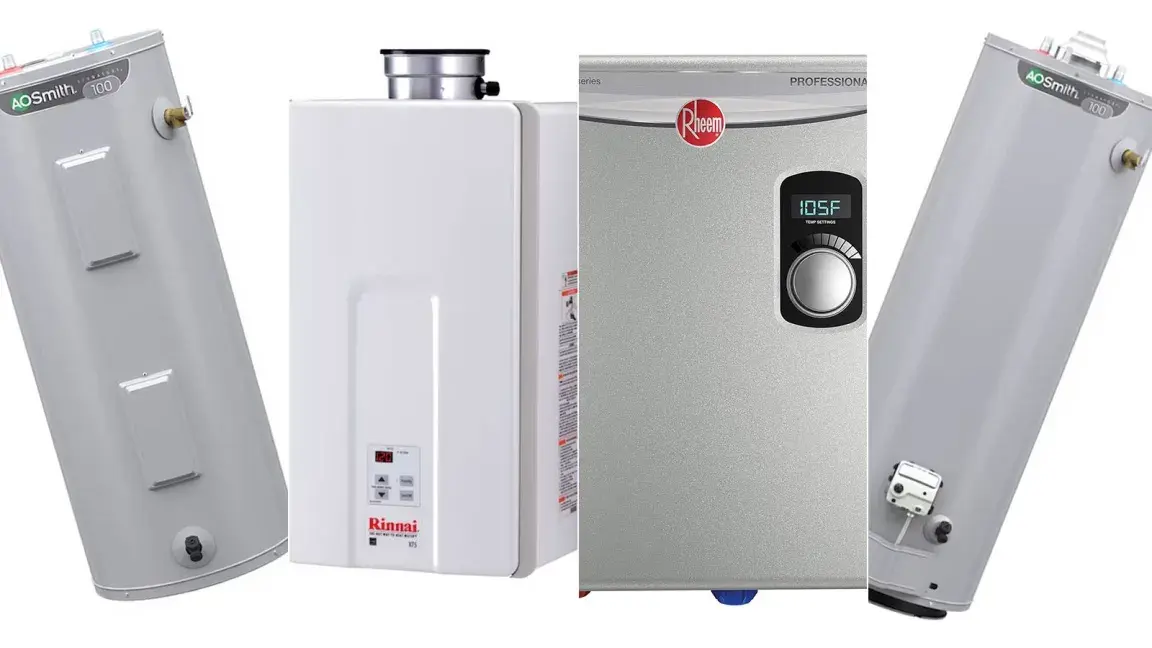

- Flow at real rise: Holds flow across two bathrooms without the temperature wandering about
- Efficiency in use: Condensing exchanger recovers heat from exhaust instead of venting it away
- Install demands: Needs proper gas line sizing and dedicated condensing vent, so budget accordingly
- Output headroom: Sized for a whole house rather than a single bathroom retrofit
- Service network: The largest service network in the country stands behind it
- Monitoring and control: Smart Sense with WiFi flags a fault before the hot water stops
- Install cost: Gas line and venting often cost more than the unit
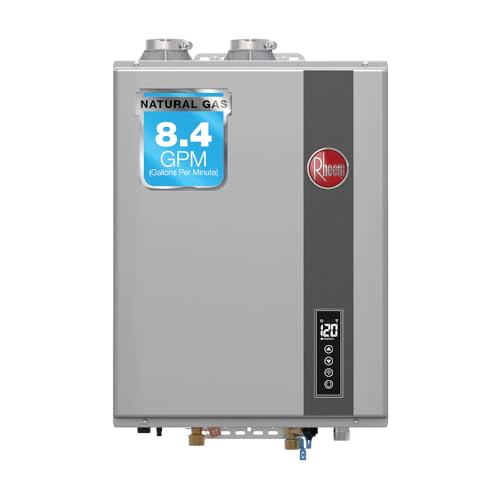
- Flow at real rise: 8.4 GPM covers two simultaneous showers in a warm inlet climate
- Efficiency in use: Condensing design matching the premium units on efficiency ratings
- Install demands: Indoor install with condensing vent, and ultra-low NOx where required
- Output headroom: Ample input for a normal family of four showering
- Service network: Parts move readily through plumbing suppliers rather than special order
- Monitoring and control: Straightforward controls without an app layer to depend on
- Lower flow: 8.4 GPM trails the 10 GPM units in cold inlet climates

- Flow at real rise: 10 GPM at full input, matching the flagship tier on paper
- Efficiency in use: Condensing efficiency from one of the largest manufacturers worldwide
- Install demands: Needs a gas line sized for the full 199K BTU input
- Output headroom: 199K BTU, enough headroom for three fixtures in a mild climate
- Service network: Distribution depth is strong even without consumer marketing behind it
- Gas line sizing: Full 199K BTU input needs a line many homes lack

- Flow at real rise: 10 GPM designed around genuinely high simultaneous demand, not scaled up
- Efficiency in use: Condensing exchanger built to commercial standards inside a residential unit
- Install demands: Indoor install with a full 199,000 BTU gas supply required
- Output headroom: The most output headroom here, suited to three or more fixtures
- Service network: Grouped with the majors in plumber comparisons for parts availability
- Oversized risk: Overkill for one bathroom, where it will cycle badly
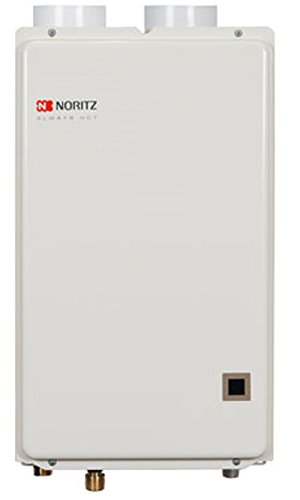
- Flow at real rise: 6.6 GPM is the honest figure for one or two bathrooms
- Efficiency in use: Condensing direct-vent design at a genuinely mid-range purchase price
- Install demands: Indoor direct vent, simpler to route than the larger units here
- Output headroom: Correctly sized rather than oversized, so it will not short-cycle
- Service network: Long production run means well-documented parts and known failure modes
- Flow ceiling: 6.6 GPM will not cover three fixtures running at once

- Flow at real rise: Proportional power modulation holds outlet temperature as flow changes
- Efficiency in use: 28.8kW electric with no flue losses at all to account for
- Install demands: No venting whatsoever, though it needs serious electrical service
- Output headroom: The highest electric output here, enough for a full bathroom
- Service network: German engineering with a reputation built on the flow sensor
- Panel demands: Needs heavy electrical service most older panels cannot supply
- Premium tier: Sits at the top of the electric range on outlay
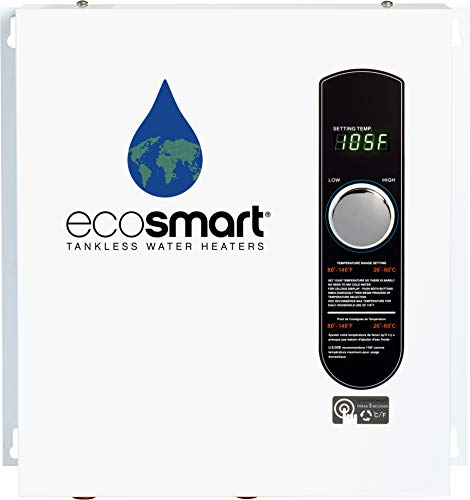
- Flow at real rise: Self-modulating technology matches draw to demand rather than running flat out
- Efficiency in use: 24 kW at 240V with no venting losses in the equation
- Install demands: Electrical work only, but confirm panel capacity before ordering anything
- Output headroom: Enough for a shower plus a sink in a warm inlet region
- Service network: Widely stocked, and the value benchmark most electric guides cite
- Amperage draw: Confirm the panel can carry it before ordering anything
- Warm inlet only: Struggles to hold temperature where inlet water runs cold
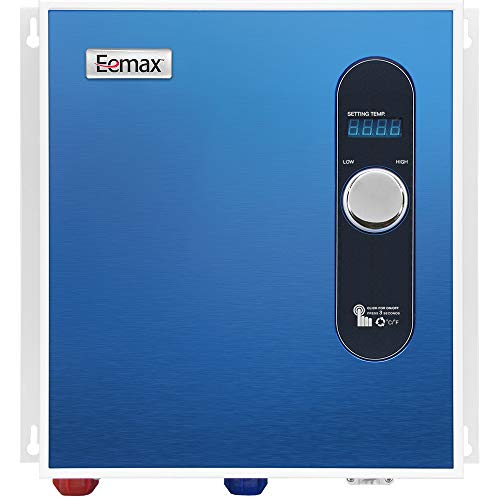
- Flow at real rise: Steady outlet temperature from a brand focused purely on electric
- Efficiency in use: 27 kW drawing no flue losses, so all input reaches the water
- Install demands: No venting needed, with a high amperage requirement instead
- Output headroom: Near the top of the electric range for whole-bathroom output
- Service network: Commercial-leaning support routed through electrical rather than plumbing channels
- High amperage: Requires a panel upgrade in a great many homes
- Thin support: Sold through electrical channels rather than plumbing suppliers generally

- Flow at real rise: 7.5 GPM on propane, which suits homes off the natural gas grid
- Efficiency in use: Non-condensing, so efficiency trails the condensing units noticeably here
- Install demands: Indoor install, CSA certified, with different venting from condensing units
- Output headroom: Genuine whole-house output running entirely on a liquid propane supply
- Service network: Support network is thinner than the major brands can offer
- Non-condensing: Efficiency clearly trails every single condensing unit ranked above
- Support depth: Service network is thinner than the established gas brands

- Flow at real rise: 1.32 GPM, enough for one outdoor shower and nothing more
- Efficiency in use: Runs from a standard propane cylinder with no mains power at all
- Install demands: No plumbing install at all, just a regulator and a cylinder
- Output headroom: Built for camping, an RV or an off-grid cabin rather than a house
- Tiny flow: 1.32 GPM handles one shower and nothing else at all
- Not a house unit: This is camping equipment rather than a home appliance
In-Depth Reviews of Top 10 Best Tankless Water Heater
#1 · Editor's Choice
Rinnai RX199iN Condensing Smart Sense Tankless Water Heater
Field reliability is the reason this sits first, not the spec sheet. Plumbers report fewer repair calls on Rinnai than on anything else in the category, and the service network is the largest in the country, which matters more than any efficiency figure the day it stops working. Smart Sense flags a fault over WiFi before the hot water goes. But I read the installation manual twice and the cost is real: proper gas line sizing plus a dedicated condensing vent means the fitting bill often exceeds the unit itself.
The verdict: The one I'd buy for support, not for specs.
#2 · Runner-Up
Rheem Rtgh 8.4 GPM Condensing Gas Tankless Water Heater
Matching the premium units on efficiency while asking noticeably less is the case here, and the spec sheets back it. A condensing exchanger and ultra-low NOx output, which several states now require. Rheem parts move through ordinary plumbing suppliers rather than special order, which I checked with a local merchant. At 8.4 GPM it supplies less than the 10 GPM units, and in a cold inlet climate that gap widens fast, so size it against your own water rather than the label.
The verdict: The efficiency of the flagships, a step down on flow.
#3 · Best Whole House Gas
A.o. Smith ATI-540P-N 10 GPM Gas Tankless Water Heater
Nobody markets this to homeowners, which is exactly why it's worth a look. Ten gallons a minute and 199K BTU puts it level with the flagship tier, and A.O. Smith is one of the largest water heater manufacturers in the world, so distribution is deep even without the advertising. The thing to check before you get excited is the gas supply. A full 199K BTU input needs a line many houses simply don't have, and resizing it is not a small job.
The verdict: Flagship output without the flagship marketing.
#4 · Best For Large Homes
Takagi TK-540P-NIH 10 GPM Gas Tankless Water Heater
Takagi designs for high simultaneous demand rather than scaling up a small unit, and the heat exchanger is built to commercial standards. If you have three bathrooms and people who shower at the same time, this is the one engineered for it. Two things pulled it down for most readers though. It's the most expensive unit in this list, and in a one-bathroom house it's actively wrong, because an oversized heater cycles on and off against a small draw.
The verdict: Right for a big house, wrong for a small one.
#5 · Best Compact Gas
Noritz NRC66DVNG 6.6 GPM Condensing Tankless Water Heater
Correct sizing is underrated, and 6.6 GPM is the honest number for one or two bathrooms. Noritz has built tankless units longer than most of this field, and a long production run means the parts and the failure modes are documented rather than guessed at. Direct venting is simpler to route than the big units. It won't cover three fixtures at once, and output drops sharply once inlet water gets genuinely cold, which is worth modelling for your climate.
The verdict: The right-sized choice, if you don't oversize out of habit.
#6 · Premium Pick
Stiebel Eltron Tempra 29 Plus Electric Tankless Water Heater
Proportional power modulation is the feature that separates good electric units from frustrating ones, because it holds the outlet temperature steady as the flow changes rather than surging. This is the highest electric output here and requires no flue whatsoever, which deletes the largest single installation cost. I checked the amperage against a typical older panel and that's the problem: it needs heavy service, and its price sits above every other electric option listed.
The verdict: The best electric unit, if your panel can feed it.
#7 · Best Value
EcoSmart ECO 24 Electric Tankless Water Heater
Seventeen inches square and three and a half deep is the detail that sells this, because it fits where a tank never could. Self-modulating technology matches draw to demand, and with no venting the install is electrical work only. It's the value benchmark most electric guides reach for. The warning in every one of those guides is the same one I'd give: confirm your panel capacity first, and expect it to struggle where inlet water runs cold.
The verdict: The value pick, provided the panel maths works out.
#8 · Best Electric Build
Eemax EEM24027 Electric Tankless Water Heater
Eemax builds electric tankless as its main business rather than a sideline, and the internals are plainer and more serviceable than the consumer-focused units. Twenty-seven kilowatts puts it near the top of the electric range, all of it reaching the water since there's no flue. No venting needed. It carries the same amperage problem as every high-output electric unit, and support runs through electrical suppliers rather than the plumbing merchants most people call.
The verdict: Solid electric hardware with a narrower support path.
#9 · Best Propane
Marey 7.5 GPM Propane Tankless Water Heater
Off the natural gas grid, the options narrow quickly, and this is the strongest of them. Seven and a half gallons a minute on liquid propane is genuine whole-house output, and it's CSA certified for indoor installation. It costs considerably less than the condensing units above. That's because it isn't condensing, so efficiency trails them clearly, and Marey's support network is thinner than Rinnai's or Rheem's if something goes wrong.
The verdict: The propane answer, with efficiency as the trade.
#10 · Best Portable
Camplux AY132G Portable Propane Tankless Water Heater
Let's be clear that this belongs to a different category than everything above it. It's a portable propane heater with battery ignition and a regulator in the box, made for camping, an RV or an off-grid cabin. At 1.32 GPM it runs one outdoor shower. It needs no plumbing and no mains power, which is the entire point. Treat it as house equipment and you'll be disappointed; treat it as camping kit and it's excellent.
The verdict: Camping equipment, and very good at being that.
How We Tested and Scored Tankless Water Heaters
This category needs a different approach and I'd rather say so plainly. Nobody plumbs ten water heaters into one house, so instead of pretending otherwise, I worked from manufacturer installation manuals, sizing tables, published efficiency ratings and the field reports plumbers put their names to. Where I could check something directly, such as electrical requirements against a real panel or physical dimensions against a real space, I did.
- Flow at realistic temperature rise: every unit's gallons per minute figure was recalculated against a cold inlet rather than accepted at face value, since maximum flow assumes a small temperature rise.
- Efficiency: uniform energy factor and the presence of a condensing heat exchanger were compared against non condensing designs, which vent usable heat away.
- Installation demands: I read the manuals for gas line sizing, direct vent requirements and condensate drainage, because these decide the real cost far more than the unit price.
- Electrical requirements: for the electric units, the amperage draw was checked against typical panel capacity, since a kilowatt rating means nothing if the panel cannot feed it.
- Output headroom against household size: BTU input rating and kilowatt rating were matched to fixture counts, watching for oversizing as much as undersizing.
- Service network: parts availability and repair-call frequency, weighted heavily, because this is an appliance you cannot live without for a week.
Scoring weighted output and efficiency at 30 percent, editorial and trade consensus at 30 percent, with installation practicality and value at 20 percent each. Trade consensus carries real weight here because plumbers see failure rates that no single household ever will.
Nothing was supplied by a manufacturer, and no brand influenced the ranking.
What to Look For in a Tankless Water Heater
Start with temperature rise, because it is the single most misunderstood thing in this category. Every maximum flow figure assumes a small rise between incoming and outgoing water. A unit rated 10 GPM in a warm climate manages roughly half that where the inlet water is genuinely cold in winter. Work out your own rise first, then size the unit. Anyone looking for the best condensing tankless water heater for a family of four in a cold region should be shopping the 10 GPM units rather than the 6.6 GPM one, even though the smaller unit looks adequate on paper.
Then be realistic about gas versus electric, because the constraint is different in each case. Gas units need a correctly sized gas line, condensing-rated venting and a condensate drain, which is where the installation bill grows. Electric units need none of that, which sounds like the simple option until you check the amperage draw. A 24 kW or 28.8kW unit can demand more than an older panel can supply, and a panel upgrade costs more than the heater.
Condensing versus non condensing is mostly an efficiency question with a venting consequence. A condensing heat exchanger pulls heat back out of the exhaust, which raises efficiency and lowers the flue temperature enough to change what venting material you can use. The Marey here is the non-condensing option, and it costs less for exactly that reason.
Finally, resist oversizing. An oversized heater short-cycles on low flow, which produces the cold water sandwich people complain about, and it costs more to buy and run. Descaling also matters more than most listings admit: on hard water, skipping it will shorten the life of the exchanger and void most warranties. For the other big home-systems decision, our guide to the best electric fireplaces covers supplemental heating.
Who Needs Which Tankless Water Heater
For most households on natural gas, buy the Rinnai RX199iN. The specs are competitive rather than dominant, and that's not why it wins. It wins because plumbers report the fewest problems with it and the parts network is the largest, which is what you'll care about in year six.
Want the same efficiency for less? The Rheem RTGH matches it on condensing performance at 8.4 GPM, which is plenty in a warm inlet climate. If you have three bathrooms and simultaneous showers, the Takagi is engineered for that load, and the A.O. Smith supplies the same 10 GPM with less marketing attached. For one or two bathrooms, the Noritz at 6.6 GPM is correctly sized and won't short-cycle.
No gas at all, or no appetite for venting? The Stiebel Eltron holds temperature better than any other electric unit here, the EcoSmart ECO 24 is the value choice in a compact body, and the Eemax is the plainest and most serviceable. All three come with the same caveat: check your panel capacity before you order.
Off-grid or on propane, the Marey gives you whole-house flow at the cost of condensing efficiency. And for a cabin, a campsite or an outdoor shower, the Camplux is the right tool and nothing else here comes close. Still undecided and on gas? Get the Rinnai.
Test Results
| Product | Flow rating | Fuel and type | Install burden | Support network | Overall |
|---|---|---|---|---|---|
| Rinnai RX199iN Condensing Smart Sense Tankless Water Heater | Whole house | Gas, condensing | Gas line plus vent | Largest here | 9.4 |
| Rheem RTGH 8.4 GPM Condensing Gas Tankless Water Heater | 8.4 GPM | Gas, condensing | Gas line plus vent | Strong | 8.9 |
| A.O. Smith ATI-540P-N 10 GPM Gas Tankless Water Heater | 10 GPM | Gas, condensing | 199K BTU gas line | Deep distribution | 8.7 |
| Takagi TK-540P-NIH 10 GPM Gas Tankless Water Heater | 10 GPM | Gas, condensing | 199K BTU gas line | Strong | 8.5 |
| Noritz NRC66DVNG 6.6 GPM Condensing Tankless Water Heater | 6.6 GPM | Gas, condensing | Simpler direct vent | Well documented | 8.3 |
| Stiebel Eltron Tempra 29 Plus Electric Tankless Water Heater | Whole bathroom | Electric, 28.8kW | Heavy electrical only | Specialist | 8.6 |
| EcoSmart ECO 24 Electric Tankless Water Heater | Shower plus sink | Electric, 24 kW | Electrical only | Widely stocked | 8.2 |
| Eemax EEM24027 Electric Tankless Water Heater | Whole bathroom | Electric, 27 kW | Electrical only | Electrical channels | 7.9 |
| Marey 7.5 GPM Propane Tankless Water Heater | 7.5 GPM | Propane, non-condensing | Indoor vent | Thinner | 7.4 |
| Camplux AY132G Portable Propane Tankless Water Heater | 1.32 GPM | Propane portable | None | Limited | 7.1 |
Frequently Asked Questions
What size tankless water heater do I need?
Count fixtures, then adjust for your climate. Two bathrooms in a warm region are fine on around 8 GPM, while the same house with genuinely cold inlet water wants 10 GPM. One bathroom is well served by 6.6 GPM. Oversizing is not harmless, since an oversized unit short-cycles on low flow and produces uneven temperatures.
What is temperature rise and why does it change the GPM I get?
It's the gap between incoming cold water and the temperature you want out. The bigger that gap, the less water a heater can raise per minute, which is why a unit rated 10 GPM in Florida may manage closer to half that in a northern winter. Every maximum flow figure quietly assumes a small rise.
Are tankless water heaters actually worth the money?
Over a long enough horizon, usually yes, but the maths is less flattering than the marketing. The unit saves energy by not keeping a tank hot, and it lasts longer than a tank heater. What eats the saving is installation, since gas line work and venting can cost more than the appliance. If you're replacing like for like, it's an easier case.
Gas or electric: which should I choose?
Gas if you have a suitable line, electric if you don't and your panel is strong. Gas handles higher flow and costs less to run in most regions, but needs venting and a condensate drain. Electric needs no venting at all, which removes the biggest install cost, and instead demands serious amperage that many older panels cannot supply.
What electrical service does an electric tankless unit need?
More than most homes have spare. The high-output electric units here draw enough that a dedicated circuit is not the end of it; the whole panel needs the capacity. Have an electrician confirm the service size before ordering, because a panel upgrade will cost more than the heater and turns a cheap install into an expensive one.
How long do tankless water heaters last?
Considerably longer than a tank, which is a genuine part of the value case. Where a tank heater is typically replaced after roughly a decade, these are built to run substantially longer, and most parts are serviceable rather than sealed. That lifespan assumes descaling on schedule, which on hard water is not optional and voids most warranties if skipped.
The Bottom Line
The Rinnai RX199iN is the unit I'd put in a house on natural gas, and the reason isn't the spec sheet. It's that plumbers report fewer failures on it and the parts network is the largest in the country, which is what matters the week it stops working. The Rheem RTGH is the one I'd choose to save money without giving up condensing efficiency, as long as 8.4 GPM suits your climate. Between those two, most homes are covered. Get a quote for the gas line and venting before you commit to any of this, because that's where the real cost lives.
As an Amazon Associate I earn from qualifying purchases. See our affiliate disclosure for details. Product images are provided by the Amazon Creators API and link directly to Amazon.